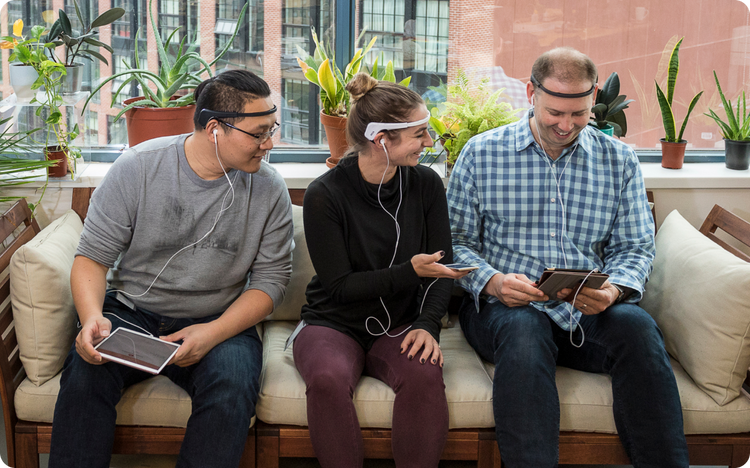
On a day which the crowd saw a man with a camera in his eye (filmmaker Rob Spence, aka Eyeborg) and a woman with a brain wave monitor hooked up to her head (Ariel Garten, a neuroscience expert and "brain guru"), the very simple ideas to use different words and admit mistakes seemed refreshingly accessible.
Read more...
Prismatic Planes HD from Alex McLeod on Vimeo.

Throw out your touchscreens, kibosh your Kinects: thought-controlled computing is the new new thing. Brain-computer interface technology has been simmering for years, and seems finally ready to bubble out of research labs and into the real world.
Earlier this year, friends of mine at the Toronto art space Site3 built a thought-controlled flamethrower, for fun. (Don’t you hate how it’s always the friends you least want to have the power to project torrents of flame with a flick of their mind who always get it?) Toronto has long been a hub for brain computing, in part because legendary cyborg Steve Mann is a University of Toronto engineering professor. Mann also cofounded the thought-controlled computing consultancy InteraXon, which built the neural installation at this year’s Olympics.
Both InteraXon and my pyromaniacal friends use brainwave-reading headsets made by Neurosky (whose promise was noted by TechCrunch five years ago) and Emotiv. Continue reading here….

Brain-controlled computing games were among 2009’s hottest holiday toys, and the pioneering minds behind Canadian startup company InteraXon plan to continue to push the frontiers of brainwave technology into the mobile computing space into 2011.
InteraXon will lead a collection of partners in the development and design of a new hardware headset, paired with the creation of a mobile interface built initially for the Apple Mobile computing platform. This will showcase several consumer applications built directly for the iPad/iPhone/iTouch system, allowing a user to interact with applications directly on the device, controlled through measurements of their brainwaves. NeuroSky, the world’s leading consumer EEG biosensor technology company joins as the guiding partner and end user, having recognized the need for a solution in the mobile computing space for this technology. (Continue reading here…).
Interaxon is a Toronto-based company that is developing thought-controlled computing technology. And it’s leading the way in this new space of tech that enables users to control applications though their brain waves. Sounds pretty trippy right?
Mind controlled games. The phrase has far-reaching and fantastic implications. But whatever picture these words might paint in your imagination, the reality is very different: at once simpler and more mundane.
GamesIndustry.biz visited the headquarters of Interaxon, one of the few software developers working in the nascent field of BCI, or brain computer interface. Fifteen years ago, this sort of technology could only be found in research laboratories. It required more than 100 electrodes and several pounds of equipment to get results. Today, the same result can be achieved with a single electrode mounted on a lightweight frame, worn on the subject's head.
More importantly, this technology is now available at a price that will appeal to consumers, a development that Interaxon CEO Ariel Garten describes as a "revolution". Prior to 2009, Garten and Interaxon's only public work had been for art installations and tech demos, but affordable, consumer-grade headsets have fundamentally changed the focus of the company.
Continue reading here....
Canadian Thought Control Pioneers Put Mind Over… by NTDTV
You can watch the video here or on Dailymotion.com.
InteraXon’s COO, Trevor Coleman and Premier Dalton McGuinty discuss the possibilities InteraXon can unleash.
In the last few years, digital media has been rocked by waves of game-changing innovation that have reshaped the ways audiences and users interact with content and technology.

Social media remapped our relationship with the Internet. Physical computing in tablets and gesture-reading technologies like Microsoft’s Kinect has opened up what it means to use a computer. The Festival’s first nextMEDIA keynote from Ariel Garten, CEO of InterAxon, gave delegates a glimpse into what the next wave of change might be: Thought Controlled Computing.
Ariel walked the audience through the many different kinds of projects in which she and her team have put thought controlled computing technologies to work. The industry changed in 2009 when new brain-wave monitoring headsets were developed that could finally be consumer facing, and not merely the province of elite research institutions.
Much more conveniently located than a galaxy far, far away, a small tech company called InteraXon on Queen West is developing products that will allow you to control your iPad with your mind. InteraXon uses software originally created by the legendary U of T engineer Steve Mann, who was dubbed “the world’s first cyborg” because of his ingenious wearable computer devices. The company’s thought-controlled computing technology translates brainwaves into digital signals recognizable by a computer—be it in a video game, automobile or robot butler. In other words, the brain’s electrical activity, which you can supposedly learn to manipulate just like any muscle, is converted by an interface into binary code. InteraXon’s first public splash was a demo during the 2010 Winter Olympics that allowed headset-equipped visitors in Vancouver to mentally control light shows at the CN Tower, Parliament Hill and Niagara Falls. The company promises more radical breakthroughs in the next couple of years, including an unobtrusive, wearable home-monitoring system that will predict epilepsy seizures and notify doctors and family.
See full article here.
Hands-free video games that rely on brain waves to control the action are being developed by a Toronto company to help people learn to focus or relax their minds.Andy McCaskey interviews Ariel Garten, CEO of InteraXon – Thought Controlled Computing. It’s no longer sci-fi, you can now interact with technology using the power of your mind (rather than your thoughts being controlled by computers.)
The system consists of a lightweight headset with two electrodes that detects brainwaves such as alpha and beta waves. Different patterns are associated with different mental states, e.g. concentrating with beta waves and relaxed with alpha, so as your mind changes states an action can be taken. Trivially, you can link your concentration to a light, so while you are concentrating on reading, the light is on and bright, but as you relax and drift off to sleep, the light dims before finally turning off.
Ariel Garten on Harddisken Radio
Ved du hvor meget du vejer? Hvad din fedtprocent er? Har du styr på hvor mange skridt, du tager i løbet af en dag, og hvor mange kalorier du forbrænder?
Og ved du, hvor tit du egentlig går ud og drikker en øl? Eller om dine gener skjuler en ubehagelig overraskelse med truende sygdomme? Og har du styr på, hvad dine hjernebølger fortæller om dit mentale velbefindende?
Hvis ikke, så er det bare med at komme igang! I hvert fald hvis man skal tro de mange, der er begyndt på det, man kalder self-tracking eller personlig dataindsamling.
Listen to the radio program here.
Interaxon is a Toronto-based company that is developing thought-controlled computing technology. And it’s leading the way in this new space of tech that enables users to control applications though their brain waves. Sounds pretty trippy right?


InteraXon es una compañía canadiense que ha desarrollado el sistema “Thought computing controlled” (computación controlada por pensamientos) que permite jugar a un videojuego controlándolo con la mente.
El sistema mide los impulsos eléctricos del cerebro para convertirlos en ondas que varían según la concentración del usuario y que un software convierte en información capaz de ser leída por un ordenador. Para hacerlo posible es necesario colocarse un dispositivo en la cabeza con sensores que analicen nuestras ondas cerebrales.
Read more…
InteraXon es una compañía canadiense que ha desarrollado el sistema “Thought computing controlled” (computación controlada por pensamientos) que permite jugar a un videojuego controlándolo con la mente.
El sistema mide los impulsos eléctricos del cerebro para convertirlos en ondas que varían según la concentración del usuario y que un software convierte en información capaz de ser leída por un ordenador. Para hacerlo posible esRead more here…

A Truly Global Gathering of Web Entrepreneurs
But LeWeb is not just about business. It was also about some pretty amazing presentations.
The standout was a thought-controlled computing masterclass from a Canadian company InteraXon. Live on stage, delegates were shown, in a manner of speaking, what was going on inside the brain of the company's CEO Ariel Garten. As she tried to speak French, the display behind her showed her brain waves shifting, showing the stress she was under. Then when she switched back to English, her brainwaves changed.
And all this came from a $200 sensor attached to her forehead. It isn't Star Trek yet, but it was not that far off.

It’s the Thought That Counts
One of the most (no pun intended) thought-provoking presentations at the recent LeWeb conference in Paris was that by Ariel Garten, CEO of Toronto-based Interaxon.
Her company is a world-leader in thought-controlled computing. This is the stuff of the future.
With a single, and relatively discreet, sensor attached to her forehead, delegates at the Paris-based event could tell if the 31-year-old Canadian was either relaxed, or concentrating. The sensor detects her brain’s alpha and beta waves and Interaxon software interprets the signals.
Spain
Japan
United Kingdom

Slowly but surely technology is seeping into airplanes, which up until a couple of years ago felt like a final reprieve from the digital world. You can use your cell phone at certain times before take off and after landing, you can watch DVDs on your laptop and you can surf the Internet using in-flight Wi-Fi.

Ever found yourself struggling to stabilize that mobile device for optimum in-flight entertainment? Toronto-based Interaxon says it may have an alternative in the form of thought-controlled in-flight games that let you keep your hands (and gadget stands) tucked away.
Yes, soon enough, you may be playing the likes of Mario Kart on your way from coast to coast--with brain power alone.

High-tech 3-D screens, thought-controlled computing, more comfortable seating and Internet connectivity are all part of the future of airline travel, according to delegates at Ontario's first industrial aerospace show held recently in Windsor.
The conference brought together more than 50 aerospace companies and suppliers exploring innovation, buyer-seller opportunities and the creation of the next century of flight.

It may sound like science fiction, but using your brain waves to control the environment around you, like the lights in your home or even your toaster, is already a reality.
One Toronto-based company has developed a system called thought-control computing and it's exploring a range of commercial opportunities that include screens on airplanes and video games.
Written by: Shane McGlaun for Slashgear.com

When I was a kid I figured that by the time, I had kids we wouldn’t need things like remote controls and light switches. We would just think we wanted them on and they would come on. There are a few thought-controlled devices on the market, but we still have to use remotes to change channels on the TV.
People are using the power of their thoughts to light up landmark locations thousands of kilometres away, thanks to a technology being demonstrated at Ontario's Olympic pavilion in Vancouver.
In what developers say is the world's largest thought-controlled computing installation, participants are changing the colours of the nighttime lighting displays shining on Niagara Falls, the parliament buildings in Ottawa and the CN Tower in Toronto.
'We can tune in brain stations'—InteraXon CEO Trevor Coleman
Pavilion visitors can volunteer to sit in comfortable chairs, wear a headset, then think about a colour.
Read more...I’m being told to empty my mind as I sit with a headset on with four electrodes – three on my ear and one on my forehead – in front of a giant screen. On a small monitor attached to my seat, I see lines that represent my laidback alpha brainwaves drop steadily down to the bottom of the screen (ah, so all that yogic downward-dogging does actually calm you).
Now I have to ramp my brain up again: I’m directed to start concentrating hard as I stare at a live screen of the CN Tower in Toronto (I could have chosen Niagara Falls or Ottawa’s parliament buildings). As my beta brainwaves go to work I make the 1,300 LED lights around the structure spin – and, not to show off, but I mean Whirling-Dervish spin. Read more...
Thought-controlled lights illuminating Niagara Falls during the winter Olympics? Maybe this will cheer up the Vancouver locals apparently dreading the upcoming games.
Toronto-based company InteraXon (which specializes in thought controlled computing) is planning an installation where visitors will be able to control live light shows at Niagara Falls with their thoughts, from Vancouver. The project, Bright Ideas, is described as the the wold's largest thought-controlled experience. Read more...
If you're in the mood to feel an overwhelming sense of power, hop on a plane and go to the Ontario Pavilion at the Olympics in Vancouver. There, you can control the lights on the CN Tower with your mind. Yes, that's right: with your mind. Read more...
It wouldn't be the Olympics without distractions; the 2006 Winter Games in Turin had their Austrian doping scandals, and the most recent Summer Games in Beijing were punctuated by an epic opening ceremony followed by rampant media censorship. Not to be outdone, Canada's Bright Ideas installation will allow visitors to the upcoming Vancouver Games the chance to control lighting installations at major landmarks in faraway Ontario using only their thoughts. Read more...
Genom att bara använda sina tankar kan besökare på vinter-OS genomföra stordåd. Belysningen på CN Tower i Toronto, parlamentet i Ottawa och Niagara-fallen kan styras med tankekraft från Ontario Pavilion. Read more...
If you're planning to be at the upcoming Vancouver Olympics, take time to stop at the Ontario pavilion and give a thought to tech startup InteraXon.
That thought could be about lighting up Niagara Falls. Or the CN Tower. Or Ottawa's Parliament buildings.
Mind-controlled computing has come off the pages of sci-finovels into real life and Toronto-based InteraXon is at the Olympics with the hope that demonstrating the technology to a world audience will help move it into the mainstream. Read more...
How many ways can you turn on the lights? The most common ways are turning a switch, clapping, or using a remote control. What about just by thinking about it?
During the Winter Olympics in Canada this month, a Canadian company called "InteraXon" is doing an experiment, in which the Olympic "visitors use their brainwaves to control the lights at three major landmarks in Canada, such as Niagara Falls." "When people put on the headsets and find themselves increasing the brightness of the lights by just thinking about it, you can almost see their brains explode," says Trevor Coleman, the chief operating officer for InteraXon. Read more...
Ontario House offers free admission to the general public in order to experience Ontario. With a daytime capacity of 450 people, visitors to Ontario House will be able to change the nightly illumination of three of the province's major tourism icons-the CN Tower, Niagara Falls and Ottawa's own Parliament Buildings-utilizing innovative new thought-controlled computing technology designed by Toronto-based firm InteraXon. After donning special headsets, guests will be taught to use their brainwaves to control the three light shows taking place in Ontario, over 3,000 km (1,864 miles) away. Read more...
Aber was ist für uns Menschen die intuitivste Steuerungsmöglichkeit? Steuerung nicht unserer Gedanken, sondern durch die Gedanken. Oder um genauer zu sein über elektrische Potentiale die sich über der Kopfoberfläche ableiten lassen. InteraXon, eine kanadische Tüftlerschmiede, möchte dieses Jahr das o.g. Konzept pünktlich zu den Olympischen Winterspielen in Vancouver im großen Stile vorstellen. So haben Besucher des Ontario Pavilion die Möglichkeit mit einer Vorrichtung ähnlich einem EEG (Elektroenzephalografie) und ihren Gedanken, Live-Lichtershows an verschiedenen Stellen Kanadas zu steuern. Read more...
“Along with the figure skating, ice hockey and snowboarding, another event will compete for attention at the Winter Olympics in Canada this month.
A Canadian company has created what it calls the “largest thought-controlled computing installation.” It’s an experiment that lets visitors to the Olympics use their brainwaves to control the lights at three major landmarks in Canada, including Niagara Falls…"
Read the rest at wired.com
Videnskaben har de seneste år arbejdet hårdt på at lave ny teknologi, der effektivt kan aflæse ens tanker og omsætte dem til handlinger. Endnu er teknologien stadig forholdsvis primitiv, og mulighederne er begrænsede.
Det har dog ikke afholdt canadiske Interaxon fra at lege lidt med teknologien og gøre den afprøvelig ved det komende Vinter OL, der går i gang i Vancouver i næste uge. I Ontario House i Vancouver kan besøgende prøve en hjernebølgeaflæser, der måler deres alpha- og betabølger, som henholdsvis er relateret til afslappelse og koncentration.
Published on Friday, Jan. 29, 2010 6:27PM EST
by David McDougall

Last summer, employees of the small Toronto tech company InteraXon were sitting in their Dundas Street West office, conjuring ways to exploit their mind-controlling technology. Maybe they could use their brainwave sensors to build some kind of telekinetic musical instrument made with singing glass bowls? Or a thought-driven heat lamp?
But the Ontario government came up with the brightest master plan. Acting on a non-extrasensory tip from the Ministry of Research and Innovation, the Ministry of Tourism contacted them, asking if they had the power to illuminate the CN Tower.
“We thought about it for a minute and went, ‘Well, I guess so, yeah. Let’s do it,’ ” recalls Trevor Coleman, one of InteraXon’s founders.
A few days later the ministry came back again and asked if they could do something with Niagara Falls and Parliament Hill, too. In what will be their biggest venture to date, InteraXon will use its special technology to send brainwaves from the pavilion at the Vancouver Olympics to those three landmarks back east.
Read more…
Figure skating? Please. The main attraction for many visitors to the Winter Olympics will be an installation letting them control the lights at Niagara Falls with their minds. That’s right: we’re all telekinetics now.
Of course, anything seemingly this amazing requires some hedging. The Bright Ideas installation by Toronto-based company InteraXon doesn’t let you decide what color the lights should be or how brightly they should shine, and it can’t tell if you’re specific thought is, say, “Lights, I command thee!” Instead:
The headset used in this installation measures the brain’s electrical output and reacts to alpha waves, associated with relaxation, and beta waves, associated with concentration. As the users relax or focus their thoughts, the computer will send a message over the internet to the site they are viewing. InteraXon’s custom software connects users thoughts to the lighting controls to change the display on the landmark site.
So basically, as long as you’re thinking hard about something, you’ll be able to control a light show thousands of miles away. In addition to Niagara Falls, displays will also be featured at Toronto’s CN Tower and Ottawa’s Parliament Buildings.
Someone, please, if you make it out to Vancouver this month, let me know what this is like. And don’t worry! I’m sure the headset’s not simultaneously recording your brain waves to somehow remotely manipulate your every thought down the road. At least, I’m pretty sure.
Original article on: www.gizmodo.com
Earlier this year Society of Women Engineers Magazine profiled InteraXon partner Ariel Garten in their cover story on women working in the field of wearable computing.
You can see us on the cover or read the full article.
CTV featured InteraXon and their Star Trek themed brainwave game in their national news broadcast's webMANIA segment earlier this year.
You can watch the video here or on CTV's site.
While they ready the chair you can levitate with your mind, there's time for a little concert ...
Water squirts and pools on the floor as Steve Mann's fingers fly across his "hydraulophone," coaxing "Twinkle, Twinkle Little Star" out of the tadpole-shaped instrument.
"It's sophisticated frolic," says Mann, creator of the hydraulophone, the water organ.
Mann is part of a team behind a little piece of techno Neverland at work on Dundas St. W. In the cluttered offices of InteraXon Thought Controlled Computing, a host of Tinkerbell-worthy gadgets are taking flight.
"It's a pretty creative atmosphere," says lead researcher Ariel Garten, about the fledgling firm. Perhaps the most thought-provoking of the projects being pursued at the funked-out facility are the games and gadgets that can be manipulated with the mind.
Your mind can even levitate a chair and influence the accompanying sound and music, Garten explains.
To run the mind-controlled devices, users have electroencephalograph sensors. These sensors pick up the tiny electronic pulses — microvolt in intensity — that buzz like subatomic bees across your head. The pulses are the signature signals of brain activity.
All of our thoughts, movements, and states of mind are the products of neurochemical cascades that run along neurological pathways in the form of electronic impulses.
"The summation of all this electrical communication can actually be read outside of your brain," says Garten, an accomplished artist and fashion designer, who also trained in neuroscience. "And outside your head the amassment of all this electrical activity is summed up ... and you can read the general trend of your brain."
The specific "trend" of impulses the InteraXon team capture are Alpha waves, which are generated when the mind is "blissfully, calmly" relaxed, Garten explains.
"So you have to relax," she says as you sink back into the cushioned chair, which dangles on a chain from a ceiling missing a few tiles.
Breathe deeply and slowly, think of ocean waves. And on a computer screen before you, a line measuring your Alpha wave output begins to spike as you will your mind to relax.
When you're calmed down enough to push the spike past a tripping line, an electronic winch begins to lift the chair.
"So, it's a really nice metaphor for a kind of meditative state," Garten says. "Everybody has always dreamed that as you meditate you could ... levitate yourself."
As metaphors go, it may be nice imagery. As a practical matter, it results from InteraXon's painstaking software programming that allows it to capture the Alpha waves, isolate them from all other electronic noise — from other computers, cellphones — and amplify them into a usable electronic signal.
"All of that is nullified and we're just getting your pure brainwave in a way that's meaningful," says Garten. And with that isolated brainwave, Garten says, anything that can be plugged in can conceivably be manipulated by Alpha activity.
InteraXon's main goal, Garten says, is as lofty as the chair.
"We're here to change the face of thought-controlled computing," she says. "(It's) becoming much more common and it's really the breaking point for this technology."
Garten describes the company as a "start up" that launched a year ago. It has five partners, who initially financed the company themselves, but buzz about their work has attracted willing investors.
InteraXon is actively developing commercial games and other gadgets for a general market.
The technology also has obvious implications for people with physical impairments, from those who suffer from such degenerative diseases such as ALS and Parkinson's, to those with spinal-cord injuries. But InteraXon's focus is to bring the technology to the general public.
And as interest heightens and technology is created — in the form of computer games and other gadgets — the sophistication will grow and prices fall, Garten predicts.
It's this technology-price cycle that will bring thought-controlled computing to the field of assisted medical devices, says Tom Chau, who holds the Canada Research Chair in Pediatric Rehabilitation Engineering at Toronto's Bloorview MacMillan Children's Centre.
Chau's Bloorview team creates devices to help severely disabled kids interact with the world.
"Of course, the more this kind of technology gets developed, the more useful it will be for our needs," says Chau.
When Trevor Coleman's friend threw a Star Trek convention, he could have slapped on some pointy-ears for a costume and attended like most fans. Instead he contributed a brainwave-controlled video game straight out of an episode of Star Trek: The Next Generation.
Toronto-based InteraXon had developed a system that measures brainwave activity using electrodes held in place with a rubber headband, then converts those readings into an output that can manipulate a computer. It's a little bit different from using a mouse and keyboard.
The Star Trek convention was perfect for the technology's first public debut, Coleman says. It just took a graphical interface made to approximate one seen in Star Trek episode The Game.
"By entering and leaving particular brain states, you can control a seat vibrator that gives them tactile feedback," he says. "Also, the video image and the game are controlled with your mind alone."
InteraXon demonstrated their technology at the Premier's Innovation Awards on Tuesday. Ontario Premier Dalton McGuinty slipped the rubber band and electrodes onto his head and shot a few discs into a moving cylinder -- the object of the game.
Featured Project:
CES2011 GAMES
Have a question?
p: +1.416.598.8989
e: info@interaxon.ca
Our office, laboratory
and demo space
160 John Street, 2nd floor
Toronto, Ontario
M5V 2E5